The Undeclared Family
Why some family cultures collapse without ever being competitive or cooperative
Some families have a winner-takes-all culture. Others are run in a more cooperative democratic way. And in between, there are endless options. I remember our father forcing cooperation onto us, yet we did not agree on a way forward. It was cripling and exhausting. Years of arguing about it slowly grinding down everyone’s souls. Not just my brother and I, but also our father and our respective mothers. Would having been set against each other to compete have been the better way? I doubt it. It rarely is that simple.
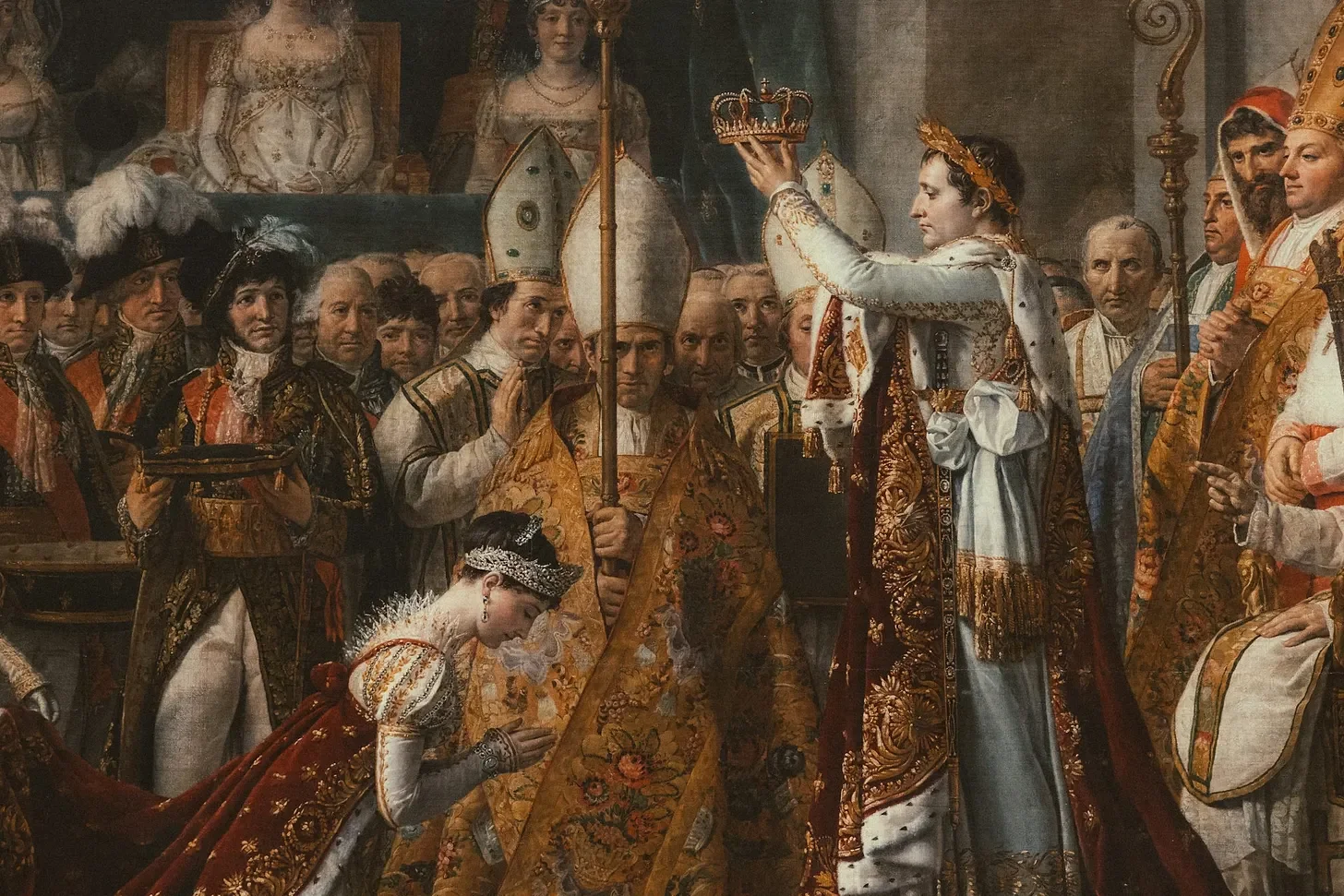
Napoleon’s Coronation: Photo by Michael McKay on Unsplash
What makes a team perform well?
It turns out I am not the only one who has wondered this. In 2012, Google set out to answer the question. The project was called Aristotle, and the assumption going in was straightforward: the best teams would be the ones with the best people. Star engineers, strong individual track records, the right mix of seniority and skill.
They studied 180 teams over two years. They were wrong.
The single strongest predictor of a team’s performance had nothing to do with who was on it. It was whether the people on it felt safe enough to say the difficult thing out loud without fear of being punished or humiliated for it. Like admitting a mistake, challenging a plan or asking a question that might make them look foolish. Researchers call this psychological safety, and Google’s data ranked it above talent, above experience, above leadership style, above everything else they measured.
This matters more than it might first appear. It places family culture above everything else. It is not, as I once assumed, simply a question of how a team is structured — who is in charge, how decisions get made, whether people are pitted against each other or pulled together. A family can be run with iron discipline or with open democracy and fail by the same mechanism: nobody in the family is willing to speak their mind.
Decades of organisational research since have confirmed the same pattern again and again, in settings far removed from a tech campus — hospital wards, manufacturing floors, public agencies. Teams that feel safe enough to disagree make better decisions, recover faster from mistakes, and outperform teams that simply get along. Teams that avoid friction in order to preserve harmony do not become safer. They become quieter.
Which raises the question: if structure alone does not determine whether a team thrives, why do so many of us spend our energy choosing between competition and cooperation, as if the choice itself were the answer?
It is, however, a good place to start. So let us look at what the research on competition and cooperation actually says and whether, like most of what matters in families, it turns out to be more complicated than most think.
Competition vs. Cooperation in teams?
The instinct, once you know to look for psychological safety, is to assume cooperation is simply the better culture and be done with it. The research mostly agrees, but not as cleanly as either side of the debate would like.
The foundational evidence comes from David and Roger Johnson, who spent the better part of four decades running meta-analyses on this question, eventually drawing on well over a hundred studies. Their finding has held up remarkably well: cooperative structures outperform competitive ones, and they outperform people simply working alone. What is less often repeated is the second half of their finding — that competition and working alone produced no meaningful difference between them. Competition, on its own, is not a performance strategy. It is a more dramatic way of being on your own.
A more recent and more careful analysis looked at the granular details. In 2012, Kou Murayama and Andrew Elliot went back through the competition literature and found something the earlier consensus had missed: across all those studies, competition’s effect on performance averaged out to almost nothing. Not because it does nothing, but because it does two opposing things at once. Competition can sharpen people: the prospect of winning focuses the mind wonderfully. It can also frighten people: the prospect of losing, particularly losing publicly, makes them cautious, defensive, and prone to protecting themselves rather than producing their best work. In any given team, both forces are usually present, pulling in opposite directions, and which one wins says less about competition itself than about how secure the people inside it already feel.
This is where the organisational research, rather than the laboratory research, becomes useful. Dean Tjosvold spent years in real workplaces rather than experimental ones, and his consistent finding was that people who believed their goals were genuinely shared with their colleagues behaved in ways that were observably different from those of people who believed they were competing with them. They exchanged information freely, built trust over time, and developed confidence that collaboration would be rewarded rather than punished. Where goals were perceived as competitive, the same employees described relationships marked by suspicion and a marked reluctance to share anything that might benefit a rival. This was not a matter of mood. Productivity and morale move together in the same direction.
This does not mean that competition has no place. A study of real four-person teams under deliberately manipulated reward structures found that competitive incentives produced faster work, while cooperative incentives produced more accurate work. Which structure suited a given person depended as much on their temperament as on the task. The extroverted and the agreeable thrived under cooperation. People who were neither did better when left to compete. Reward structure, in other words, is not a verdict on human nature. It is closer to a key that fits some locks and not others.
Cooperation is, on average, the better choice, but competition is not simply a worse choice; it is a more volatile one, prone to backfiring whenever the people inside it feel the threat more than the opportunity. However, if the goals are aligned well with the competition it can outperform. It is also a question of the character of the people inside the team. Some do better in cooperative environements and other’s in competitive oens. All of this raises the question for anyone trying to apply any of this to a family: what happens when the stakes are not a quarterly bonus, but the only inheritance you will ever have, and the people you are competing against share your blood and your childhood bedroom?
How is this in families?
A family is not an ordinary team, and it is worth mapping out the differences. A disappointing colleague can be managed out. A losing salesperson can change departments, or companies, or careers. A son who loses the family business does not get to resign from being a son. There is no clean exit, no neutral severance package, no new team to join next quarter. Whatever structure a family runs — competitive, cooperative, or something never quite decided — it runs for life, and frequently for generations after the people who built it are gone. In a business family we hold several roles, that have a strong effect on the team dynamics. We are often child, parent, sibling, CEO and owner all together.
An anthropological study out of the Max Planck Institute looked at this question from an unexpected angle: not wealthy families at all, but the games that different cultures around the world have historically played. The assumption going in was that hierarchical, unequal societies would invent competitive games, and egalitarian ones would invent cooperative games. The actual finding inverted this. What predicted a culture’s taste for competition was not how equal it was internally, but where its conflicts were pointed. Cultures locked in frequent disputes with outsiders developed more cooperative games. Cultures with little external threat but unresolved tension among their own members developed more competitive ones. Internal peace, in other words, does not produce cooperation by default. Left without an external enemy, a group’s unresolved tensions tend to turn inward and sharpen against each other. While I struggle to define our famliy culture as either cooperative or competitive, I can observe that I was always more drawn towards team games in my sport endeavours, than single sports. This could be a sign that our family culture had a more competitive nature.
Reading this think about your own family and how this might apply? What culture do you have? And how does this reflect your eagerness to cooperate or compete?
Closer to home, researchers at the Max Planck Institute for the Study of Societies in Cologne interviewed members of Europe’s wealthiest families and found that most fall into one of three temperaments toward their own ownership. Some see the business as a gamble that only a singular, almost reckless founder could ever have built. Thus they treat the wealth it produces as something to extract and convert into private money as soon as possible, rather than trust to the business’s own uncertain future. Others see themselves as custodians of something that, in a sense, belongs to itself — a duty passed down rather than an asset owned, with the cost that whichever heir does not inherit the duty is expected to step aside quietly. And others come to see the family itself as the real asset, the company merely one investment among several, with shareholders functioning almost as a small, deliberately managed democracy designed to keep even the smallest stakeholder feeling heard. Aristocratice families tend to fall into the group where we are seen as custodians and one heir is selected (usually the eldest) to carry the inheritance into the next generation. This is still a very common group in the german speaking region, even outside aristocratic families.
A companion study, following thirty-two interviews across nine such families, found something interesting: the degree to which a family’s wealth was concentrated in few hands or spread across many predicted, whether that wealth strengthened the family’s bonds or slowly poisoned them. In the most concentrated cases, researchers documented decades of open warfare between siblings. In one case with the controlling brother routing the entire business into a foundation for the specific purpose of removing his own family from it. In the most distributed cases, by contrast, families had invested years of deliberate work into staying close. One even held something like a funeral for their founding business after the forced sale of it, with candles and the kind of grief usually reserved for people rather than companies. Then rebuilding itself around the wealth that remained. Looking at my peers, I can confiedently say that the families that tend to prune the family tree, in other words select one heir, distance themselves over time. I do not know my 4th or 5th cousins. I can check in the Gotha and reserach them, yes, but we don’t have the close bond like in families that have a business together and have regular family days.
A separate and very recent study of German wealth-transfer norms adds some flavour to all of this. Most people, when asked, insist siblings should inherit equally — it is one of the few things people across the wealth spectrum still agree on. But the wealthy are an exception the moment a business is involved: suddenly, giving control to whichever child can actually run the thing sounds reasonable, even though nobody would say the same about the house or the cash. Families that think of themselves as fundamentally cooperative are, on this one point, running a small, undeclared competition and calling it something else.
Japan offers an extreme version of this same instinct. For centuries, Japanese family firms facing an unpromising heir have simply adopted a better one — an adult son-in-law, formally taken into the family and given its name, chosen for competence rather than blood. It is a strange thing to encounter for the first time, and a stranger thing to discover that the economics back it: firms run by these adopted heirs consistently outperform firms run by disappointing biological ones. The mere possibility of a comeptent heir being addoped disciplines the natural heir into trying to earn their place, rather than simply waiting for it. This is one of the main reasons why japanese family business last longer than anywhere else in the world. But are they still truly family businesses? This is an extremem example of a highly competitive culture, where the business is put before the family.
How do we create an ideal Culture?
We dived deep into the science of team performance and family culture. But what does all of this tell us? How can we use this to our advantage? As always, there are some universal nuggets and a lot where it depends. If we imagine competitive culture as one extreme and cooperative as the other, the ideal is probably somewhere in between. And it depends on the characters in the famly. Not every family has the potential for a cooperative culture. And every family will have members that won’t perform in a cooperative setting. Yet, what truly makes a family work well is creating psychological safety. Coopperation of competition is not the question. Can you voice your differences? Lets see how we set up the ideal culture.
The first question to answer is: which family capital is the most important? Can you rank the five capitals in order of importance? That would be the first basis. You can find more on the five capitals here.
Most families I know and work with see it as important to keep the family together and keep harmony in the family. Which means that a predominantly cooperative culture is the best fit. However, as we learnt, we need psychological safety for the family to perform. Learning how to have productive conflict is one of the corner stones of this. The basis of a cooperative culture is to establish a fair and just family system. While equality is often wished for by many, it is not the culture that performs well and often breads sentiments of unfairness.
Sprinkle in competition where you can. Even if the family culture is at heart a cooperative culture, there should be some aspects of competition. However, the rules need to be clearly defined. What is expected? How is the winner selected? What does it mean if you lose? THis is just as important if you opt for a competitive culture at hear. We want to make sure that the goal is clear and we get the best out of people. We need to try to avoid triggering sentiments of loss aversion, which is the downfall of any competitive culture. Sports teams are often a good example: while often cooperative at heart, only (if we take football) 11 people can stand on the pitch at the start. It is a cooperative game, but competition for the spots is there. The teams that can foster a cooperative culture while keeping competition at it’s best are the ones that perform the best. The same can hold true for a family.
It is not easy to create a culture where family members perform, while their well-being is also high. If well-being is prioritised too much performance drops and vice versa. Paradoxically they actually move in tandem. With falling performance also well-being tends to fall. And when well-being falls, so does performance. Thus you need to prioritise them equally to get the best out of people. We may be able to compensate for a short while, but not for long. Families whos culture goes into toxic territory are on their best way to demise. I have not just seen this, I have lived it.
To be sure your culture does not go haywire, audit it regularly. Are we still adhering to what we set out to achieve? Are our rules still applicable now? Are people following the system that we have mapped out? What is still working and what is not?
Closing Answer
To answer the question set out initially. The problem we had was neither cooperation nor competition. There was a lack of psychological safety and a lack of trust that eroded the family culture. And a lack of definition. There was no defined goal for us to work toward. There were no clearly defined rules to work with. We were caught in a culture that no one really understood nor could define.
We were not competing and we were not cooperating. We were undeclared.