The Neurodivergent Heir: an Introduction
There might be more behind your rebellious heir.
Most of us do not realise how rampant neurodivergency runs in business families. In this article, I will shine light on this topic. It will be the first article in a series on this topic. The topic is close to my heart. So welcome to the first edition of The Neurodivergent Heir column. In this column, I will focus on this topic.
I was diagnosed first with ADHD and then with Autism in 2024. You might think this would bring your world down; however, for me, it was liberating. It explained so much that I have always struggled with. In my teens, I was diagnosed with giftedness. However, giftedness in combination with AuDHD (ADHD + Autism) comes with a specific set of challenges. You will end up a failed prodigy if challenges coming from AuDHD are not recognised.
Before we get into the specifics of Neurodivergent Heirs, let's cover the basics.
What does “Neurodivergent” mean?
Essentially, Neurodivergent refers to people whose brains function differently from the norm, as opposed to Neurotypical. A look at the Oxford Dictionary below suffices.
differing in mental or neurological function from what is considered typical or normal (frequently used with reference to autistic spectrum disorders); not neurotypical. - Oxford Dictionary
A host of brain types and neurological disorders fall under this term. Basically, anything that is not part of the norm. The important distinction here to make is that Autism, Dyslexia, Dyspraxia, ADHD and many other “disorders” are essentially differences in how the person’s brain works. These differences come with advantages and disadvantages. However, our world is built for neurotypical (normal) folks. Thus, neurodivergent people will struggle. Also, there is degrees to this. All of these brain types come on a spectrum. In Autism, for example, we distinguish between high needs and low needs autists. In the past, the low needs were also termed as Asperger’s or functioning autists.
In general, neurodivergent people struggle with executive functions. The image below lists them. These functions are basically your brain’s air traffic control system. We will not go into details in this edition. However, while neurodivergent humans struggle with these, they excel in other areas such as creativity, debating, reasoning, pattern recognition, problem-solving, crisis management etc.
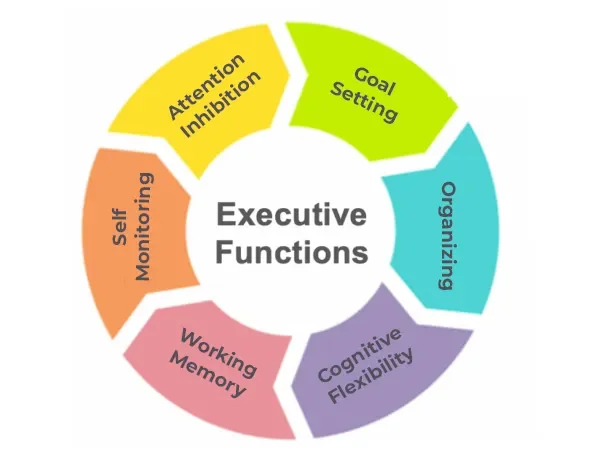
National Institute of Health
Neurodivergence meets Wealthy Family
Only 5% of the wider population is diagnosed with ADHD, and about 20% of the population is defined as neurodivergent. Looking at these statistics, one might think this is hardly a significant issue for wealthy families. However, neurodivergent brain types are genetic. Genetics determines whether you have it, while your environment determines how strongly it manifests. Current science suggest a 80% genetic and 20% environmental ratio. And now comes the key point: to gauge how common these are in wealthy families, we need to look at entrepreneurs.
According to Durham University, “A 2018 study on the prevalence and co-occurrence of psychiatric conditions among entrepreneurs showed that they experience more depression (30%), ADHD (29%), substance use (12%), and bipolar disorder (11%) than comparative participants.”
As we can see, the ratios are much higher for entrepreneurs than for the wider population. The reasons for this are many. However, the primary reason neurodivergent people are more prone to entrepreneurship is that we do not fit within a typical corporate structure. Neurodivergent people think differently and work differently, and modern organisations are not designed to accommodate this. Also, the strength of neurogivergence, such as a higher tolerance for risk, problem-solving, and hyper focus, makes us good at it. Shockingly enough, the unemployment rates for neurodivergents are high. For Autists, the unemployment rate is about 80%. Autists also have a 9 times higher suicide rate than the wider population.
Now, how do most wealthy families create their wealth? Yes, correct, through entrepreneurship. This means that we can conclude that these statistics will be similar, if not identical, for heirs. On top of this, another study suggests that 70% of entrepreneurs suffer from a mental illness (this most likely includes neurodivergent brain types, as it is still widely viewed as a disorder). The connection is also not to be underestimated. Neurodivergent children receive about 22,000 more negative interactions than neurotypical children. You read that correctly, twenty-two thousand. That this creates problems like depression, suicide, hoarding, etc. is not a surprise.
So, given the statistics, we can surmise that not only is neurodivergence a huge topic for heirs, but their parents most likely also suffered from some mental condition. Looking at my own family and the families I know, I can attest to this.
Why is Neurodivergence important for heirs?
We established the prevalence of neurodivergence among heirs. Now, it is important for that reason. However, it is easy to dismiss this and continue as is. Neurodivergent heirs function fundamentally differently from neurotypical heirs. Most succession and governance processes are designed for neurotypical heirs. Given the statistics we discussed, the likelihood that these processes and frameworks work is low. Your heirs also won’t deliver their best in a corporate setting. Sitting through a 5-hour board meeting? Good luck with that. Expecting your heirs to be conformist? Also, good luck with that. Family governance needs to be fundamentally rethought. For many reasons, but especially for this one.
The way we educate our heirs needs to reflect this possibility. Also, every child should be assessed for neurodivergence. It makes such a huge difference to know. Not just for school, but for vocational education and choices. There is nothing more painful than growing up with expectations you cannot meet. Expectations of others and yourself. This relates to the failed prodigy. Gifted neurodivergent heirs can often mask their ADHD or Autism traits in school due to their high intelligence. For example, by not needing to study to do well. Or by analysing social interactions and running through scripts.
Neurodivergent heirs are often labeled negatively. They are called lazy. They are called incompetent. They are called rebellious, difficult, obnoxious, weird, antisocial, you name it. Remember the 22,000 more negative interactions. The more you are expected to perform, the more these negative interactions will occur. High expectations are placed on heirs in general. An early assessment will help mitigate this. If your parents, caregivers, tutors, and teachers know, your upbringing can be tailored accordingly.
What is Next?
As mentioned in this column, we will cover all topics related to neurodivergent heirs. In the next issue, we will cover what it means for neurodivergent heirs to grow up in a wealthy family. How this may affect them and the family. And what it feels like to develop in such an environment.
Links to statistics: