Money bought me sleep. It did not buy me love.
I spent eight years of my life in boarding school. Before that, my nanny raised me. Standard practice in an affluent household.
At ten, I was sent to the Altenburger Sängerknaben, a boys’ choir with its own boarding house in Austria. We attended local schools of our choosing and returned to the boarding house afterwards. I still remember the mixture of excitement and sadness when I arrived. During the first week, I could barely sleep.
The school bus from home would have taken nearly 90 minutes to reach my school. An odyssey starting at 5 am every morning. My parents deemed this unacceptable.
Money bought my parents more time for other things. And it bought me more time to sleep. But did it buy me more love?
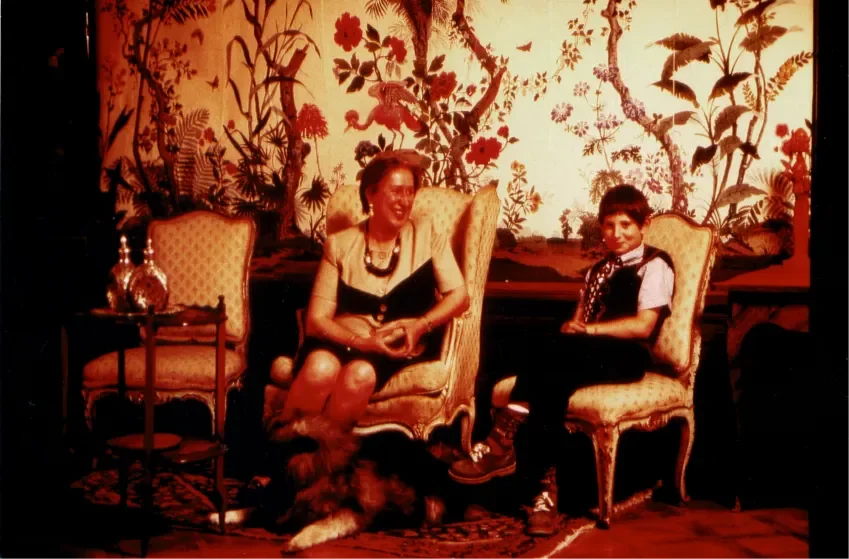
Octavian with his mother
Can love be measured?
Measuring love is a fool’s errand. Or so we believe. There is a currency for love; how else would we feel loved or not? How does our subconscious register and account for love?
Money is the currency of our economy. It performs three functions: Unit of account, medium of exchange and store of value. So, if we try to measure love, the currency we use must fulfil these three functions to be a currency.
How do you account for love? What unit do you use? It helps to think back to the time you were a child. Children don’t understand the concept of money yet (at least very young ones). You cannot buy their affection with money. Infants feel love through physical touch, responsive care and eye contact. For younger children, it is your undivided attention, playtime, listening to them and guiding them through emotional outbursts. Children show affection by giving you their time and attention, and they do that with each other. This is the exchange medium at play. Time spent with each other can be intense and short or gradual and prolonged. What matters is the total time spent together over a period of time. Thus, you can bank it and it serves as a store of value. Research by Jeffrey Hall has shown that it takes 200 hours of time spent together for two adults to become close friends. This gives us a good indication that time can be a store of value.
We can distil this down to the currency of love being time. However, time on its own would be insufficient. Attention is another aspect of love. Children do not feel loved when you spend time with them while you are on the phone. Or if you have guests and you are just there as a trophy of sorts. So the currency of love is attentive time. Time that you spend with someone while fully present, giving your attention to the other person.
The cost of a thing is the amount of what I will call life which is required to be exchanged for it. — Thoreau
Thoreau’s words sum this up beautifully and give us a great segue into resource theory by Foa & Foa. They argue everything exchanged between people falls into six classes: love, status, information, money, goods and services. Love here means care, kindness, emotional support and intimacy, not romance alone. Their work distils down to three exchange rules: It is best to trade similar resources. Shared time is a precondition. And substitution fails.
They place love and money at opposite ends of their theory. Thus, love cannot be replaced with money. Yet, affluent parents attempt this all the time. This is a classic affluent time fallacy.
The affluent time fallacy
For most wealthy families, there is a strong focus on their financial wealth. The inheritance for the next generation gets much attention.
They are tight-fisted in guarding their inheritance, yet when it comes to wasting time, they are most lavish with the one thing where greed is honourable. — Seneca
As Seneca describes, our time is the most important resource we have. Yet, we squander it away. For people who are not affluent, time is essential, and often time is traded for money. Once you have enough financial assets, this equation does not hold up anymore. We can make more and more money, but we cannot gain more time than we have. A day stays a day and holds only 24 hours. Incidentally, with more wealth, time becomes to feel ever so scarcer, while in reality it stays constant. We can only enjoy the things our money brings us if we can spend the time on them. And every minute we spend on leisure is a minute we cannot spend on work. So affluent people try to outsource as much as they can, leveraging their financial abilities. According to Linder, this also leads to affluent individuals trying to make leisure time more “productive”. So any activity that cannot be enhanced by adding goods or money loses out. Long courtship being one, home-cooking another and ultimately raising children. Many of these are substituted with faster versions or outsourced. A classic example is the raising of children. Nannies, tutors, cribs and expensive boarding schools. This leads to unstable relationships in the family. Not just between parent and child, but also between the adults themselves.
The more engaged time we spend with teenagers, the fewer behavioural issues they have. Less substance use, less depression, less delinquency and lower suicide risk. However, all of these are elevated in affluent families. We would think that affluent adolescents fare better than those from poorer households. The reality is that they are equally as bad, maybe even worse. The fringes of society have more in common than we would think. The work by Luthar in the 90s accidentally showed this. The affluent children were supposed to serve as a control group for her research on poorer households. Yet, they did not. The affluent children reported higher levels of anxiety and depression. Luthar initially also held the assumption that affluent parents would be more accessible to their children. However, it turned out to be the other way around. Affluent children suffered just as much from parental isolation as their poorer peers. Another mechanism behind this is that, often in affluent families, love is replaced by performance expectations. The children feel they need to perform to be seen and loved. In my experience, those who cannot perform positively will do so negatively. The aim is to gain the parent’s attention. Self-medication and peer status come into play here too.
It reminds me of my change in perspective when I turned 15. Up to that point, I was a diligent student. At 15, it hit me that no one cares, so I might as well have fun. Thought and done. My grades got worse (only slightly, though), and I focused on climbing the social ladder at school.