Family Legacy: Prison or Dove?
It starts as a prison for most heirs. It does not have to end as one.
Whenever I am in the ancestral hall at Hardegg Castle and I stand in front of our family tree, I can feel our legacy’s weight upon my shoulders. For many years of my life this weight felt suffocating. A thousand years of family history on a man-tall painting. Intimidating. For many years of my life I hated it. The unwanted attention locally and at school, being singled out by teachers and classmates. Being known by most, yet knowing hardly anyone. The obligation of the family name and history. It was all confusing. Why was I so different? I tried to push it away. I tried to simply be normal. At some point I accepted it. And some time later I integrated it. I turned my prison into a dove. A dove that gave me a direction and vision for my future. How a legacy is handed down matters. It shaped what I had to work through. But it does not decide the outcome. In the end, you either use it or are used by it.
What is a Family Legacy?
This is the first question I had to answer for myself. I hated the family legacy, yet one day I realised that I don’t even know what I am despising. This realisation prompted me to ponder. The result was that I started reading into the topic and researching it. Not only that, but I actively tried to understand more about our family legacy and history. And to realise what a family legacy encompasses.
A family legacy is essentially everything that is passed down to you. And I mean everything. The good, the bad and the ugly.
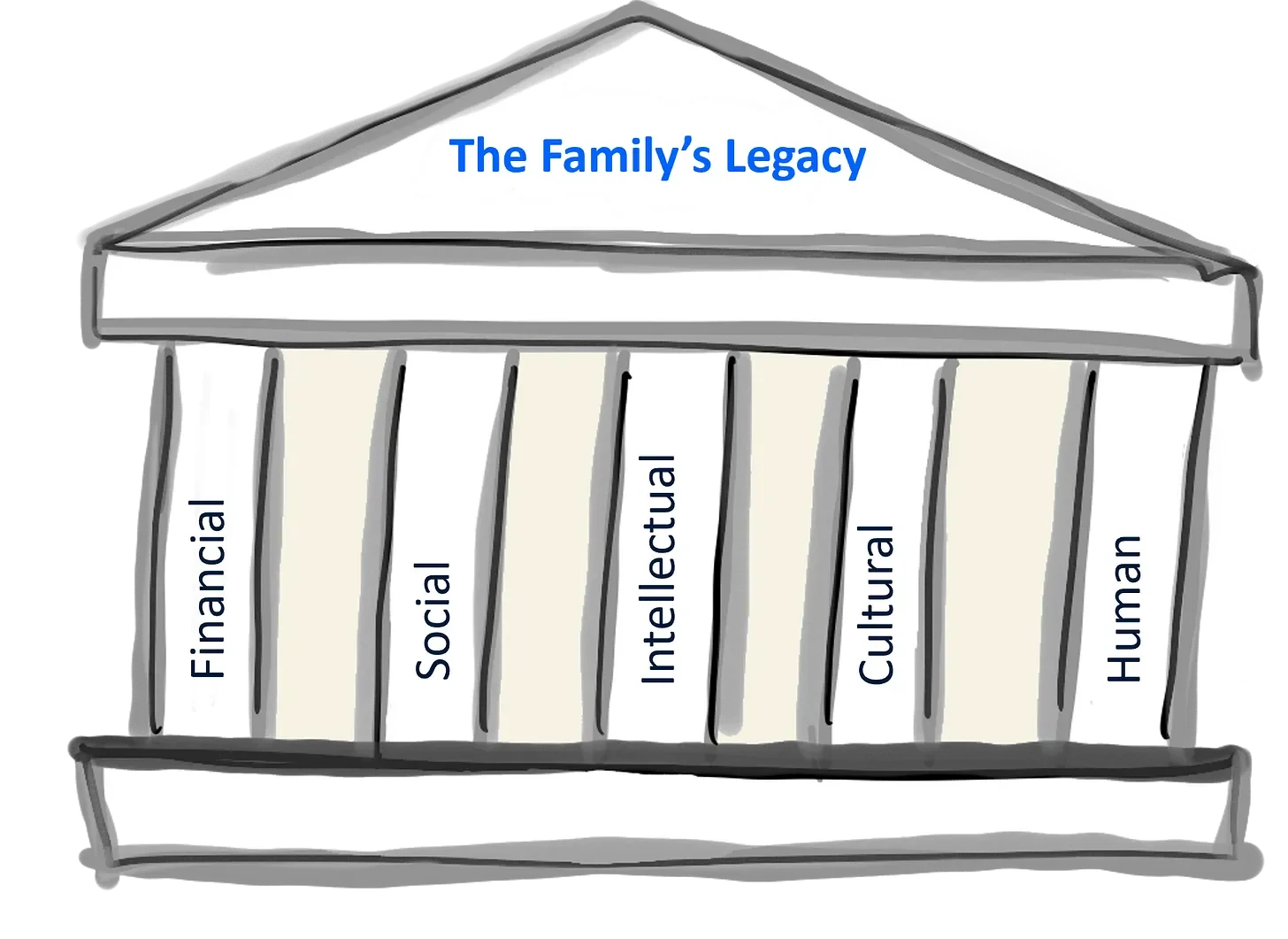
Sounds intimidating, right? And that it is. Where can one start to even get the whole picture? I personally like to segregate the family legacy into 5 different capitals. The Image below shows them:
Cultural
Financial
Intellectual
Social
Human
Spells out as CFISH and is easy to remember that way.
Pierre Bourdieu introduced cultural capital as symbols, ideas, tastes, and preferences that can be strategically used as resources in social action. Cultural capital essentially describes the habitus of your family. How family members interact, how the family acts as a whole, how the family thinks or deals with conflict and emotions. Family culture directly impacts business culture. Again, some habits of the family have more positive effects and others can have negative effects. A family’s values fall under this here
Financial Capital is your family’s monetary capital, assets such as your business, real estate, etc. There really is not all that much to say here. Your financial capital is a means to an end, it is what will make you be able to do certain things or buy things. With money often comes power in our society. And with power, you can do good and bad.
Intellectual Capital is similar to human capital; however, it is not based on the individual but on the family as a whole. This is knowledge that may be passed down through generations. A classic would be a secret recipe or other knowledge that is crucial to the family’s success. It describes the intangible assets of your family, that give it a competitive advantage.
Social Capital is “the networks of relationships among people who live and work in a particular society, enabling that society to function effectively” (Oxford Dictionary). Your family’s reputation and network fall within this place. In many cases, your surname can be an asset. You will have opportunities based on which family you were born into. A good reputation is arguably more important than financial capital. Based upon your relationships and reputation people will decide to work with you or not.
Human Capital encapsulates the people in the family, so the family members. However, any long-standing employee is part of your human capital. No matter what a family member does in their life, they have a certain skill set, they have a specific character, and their personal motivations. Some of these traits will add positively to your human capital, while others might have negative additions to it. Human capital is used by economists to give “a value to personal attributes considered useful in production processes”. So, in our case, essential personal attributes for the activities a family engages in. In families, another thing that falls into the human capital bracket is family genetics. This is a capital that is given from one generation to the next. Strengths and weaknesses both.
By The Antifragile Family
Why can it be a Prison?
The family legacy can become a prison. It can hamper your individual development. But why? For me, it was a prison for a long time. It felt like there was a predetermined path for me. No other was available. Any attempts to break out quickly led back to the same path. I decided to study engineering in the UK on a scholarship, yet my father’s expectations pulled me back, and I went to Vienna instead. I even explored joining the military to get away. It felt like I would stumble into thorn bushes at the roadside, making it only a bit of a way before giving up, returning scratched and bleeding to the path given to me. I am not alone with this experience. Countless heirs feel similarly. In many families, the predetermined path was or is part of the family culture. It has always been this way.
Tradition is often the main reason for the prison. Tradition can be so strongly ingrained that anything deviating from it is out of the question. This comes with expectations. Expectation to choose accordingly. Expectation to perform accordingly. Expectation to behave accordingly. To be as expected.
It is often assumed to be the best way. The only way. It is assumed that one will behave accordingly and do as they are told. The artist becomes an operations manager. The historian becomes a CEO.
Now, these expectations and assumptions can be loud and direct, the elders telling the heir exactly this. But they can be quiet and subtly implied. And the worst is when the heir feels this way, but the elders never meant it like this. This is more common than one would think. No one ever expected or assumed it, other than the heir themself. The day the heir realises can be crushing. In my case, it was loud; I was told what was expected. In the case of some of my friends, it was the implied. And I see many in my work who believe it is, yet no one does expect.
The weight of the ancestors’ achievements creates this pressure. The stories we tell ourselves and are told create this prison. A prison that stops us from developing into our true selves.
However, there is more than just this that can create a prison. The business & financial structures are often complex. So complex that changing them becomes an odyssey. Moulding the wealth to fit your path is harder than moulding yourself to fit with them. A destiny that many succumb to. But it is not theirs.
Our emotional and physical well-being can greatly depend on the family and the legacy. For one, the family’s genetic material may leave us with genes that make tracking our chosen path difficult. The culture around health may be hindering our development. If there is a history of addiction or depression, we are given one extra shackle to remove before we can freely set out.
Now, the ultimate choice is yours. Will you let the legacy be the prison bars? Or shall it be the dove leading the way?
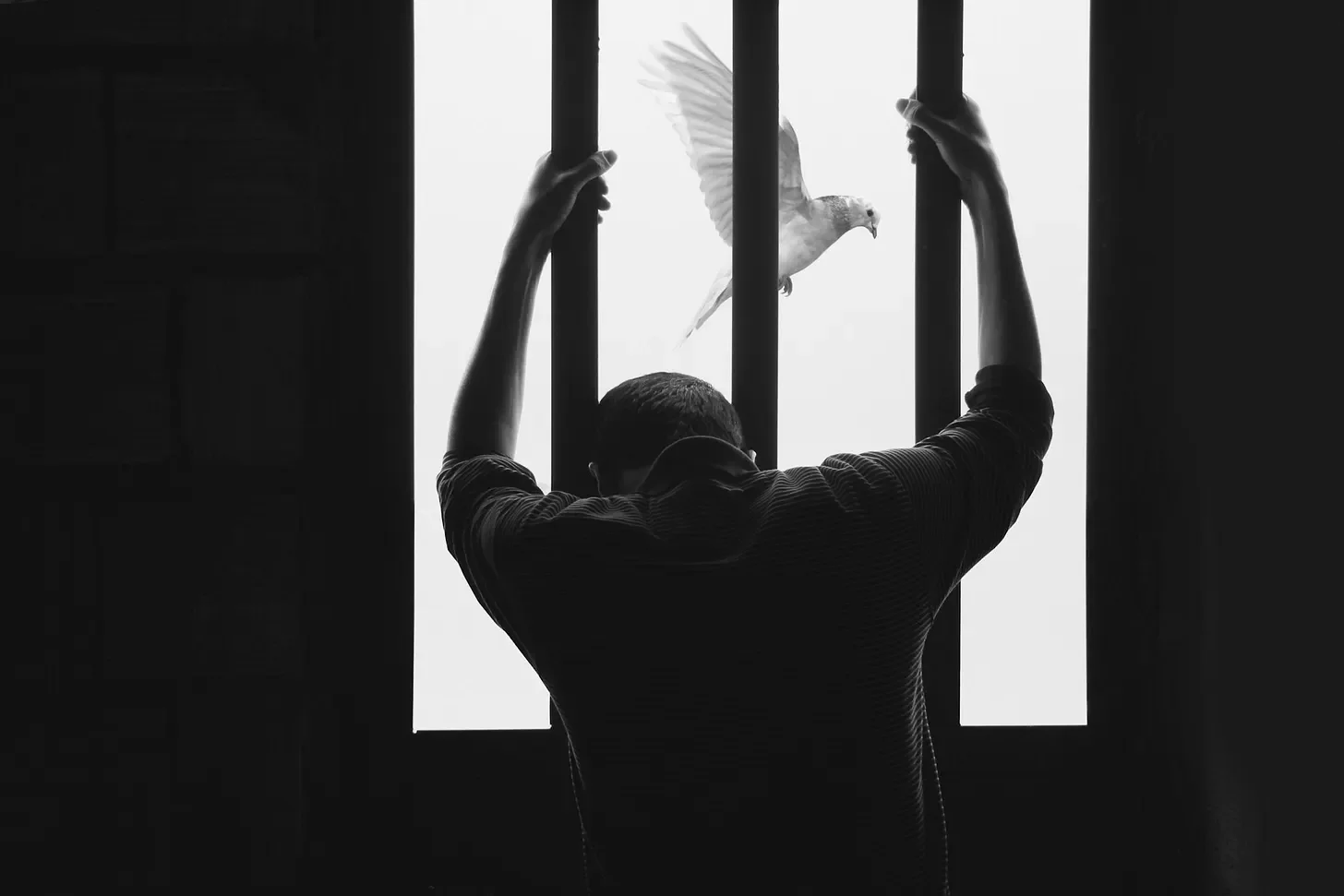
Photo by Hasan Almasi on Unsplash
How can it be a Dove?
In most cases, the family legacy starts as a prison. Turning it into a dove is where the magic happens. Many heirs need to figure this out by themselves, like I had to. With the right guidance, it need not be that way.
Getting to the bottom of this yourself is a journey. The sequence of the journey is the same for nearly everyone. We start off embracing the expectations and assumptions. Diligently treading on the predetermined path. Trudging along, till we start to notice that we don’t enjoy the path. We dislike the scenery. We dislike the topography. And ultimately we dread the destination. This is the time we start to try and leave the path. We search for forks in the path. Only to realise they all lead to the same destination. Then we try to find a way through the brush. Then we will halt in our steps and remain for a time, exhausted, frustrated, and hopeless. Once the season changes, we realise it becomes easier to leave the path. In winter we can see more clearly, yet the going is harder. That is the time we can finally endeavour to find our chosen path.
So in simple words: we do what we are told or believe we need to do, till we can no longer. We will fall into despair, hating the legacy, till we realise it is upon us to change it. That is the moment we can start to reflect and change our destiny little by little. Not everyone manages to go the whole way. Some may never stop being diligent, and some remain in hatred forever.
Despair is instrumental and the critical point. It is this moment that gives us the chance to change things. The realisation that we have not been true to ourselves. You need to grasp it with all your might and pull yourself out using it. Don’t let the despair become the standard. Use the anger you might feel to fuel the necessary changes. First of all you have some catching up to do. Most of your peers have had the chance to explore and experiment. You might be late to it, but don’t miss out on it. How else can you know what you might want? Resist the pushback from your elders. It is sure to come and will come with force. Read, travel, talk to interesting people; it is that simple to start. And during your meandering, there will be a day when you see the dove, and you will know to follow it.
I mentioned guidance earlier on. So, if you do not want your children to suffer the legacy prison, you have some work to do. Simply telling them that they can do whatever they want is not enough. This creates a whole different type of prison. Aid them in their endeavour. Give them ample opportunity to experience many different things. Sign them up for music classes, art classes, and travel with them. And when they hate something, let it go and try the next. But don’t let them quit because it is difficult. If they like it and are good at it, you have found a gem. Make sure they learn the necessary grit.
The hardest legacy prison is the one the heir has fully built themselves. And it happens under the watch of parents who truly mean well. For a young child, their parents are their heroes. They look up to you and want to be like you. This is the other side of the coin. Let them experience what it means to be like you. Take them to the office and show them. If they want to step in your shoes, they need to understand what that entails.
So you see, the balance is important. Guide them to experiment, but also guide them through the family legacy. Show them what it means.
The goal for both the heir who is figuring it out themselves and the parent who is guiding their child is to make sure the family legacy is properly integrated into the heir’s identity. But what does integrating mean?
To fully integrate the family legacy means that you accept it. And you accept that it is part of you. Furthermore, you decide which parts you want to use and which you don’t. It is paramount to understand that a legacy is only part of you, not that you are the legacy. The legacy is something for you to gain from and to build upon. At one point, the dove lands on your shoulder. And that is the moment when you truly are in charge of your own destiny.
Suggested Reading
Before we conclude. There is a few books I would like to suggest to the readers. Books that have helped me in this journey and that I think anyone will find valuable.
Man's Search for Meaning - by Viktor Frankl
The Quest to Legitimacy - by Jamie Weiner
The myth of the Silver spoon - by Kirstin Keffler
It Didn’t Start with You: How Inherited Family Trauma Shapes Who We Are and How to End the Cycle - by Mark Wolynn
Closing Words
We have no control over what our ancestors have achieved. We also have no control over the expectations and assumptions about us. The only control we have is over our own decisions and actions. It might take a couple of years for this realisation to hit home. It is unpleasant to face this truth. However, the fight is definitely worth it. And if you can avoid this fight, the effort to support the next generation early on is especially worth it.