Not Every Family Is Meant to Stay Together
Why a family that cannot leave cannot really stay
I remember to this day my frustration. Frustration that arose from arguments with family. Family we shared an office cooperative with. Call it a sort of multi-family office, if you will. We shared office space and employees, but every family member owned their own assets. My dad had taken me along to a council meeting about reducing employee overtime. He wanted me to pitch my solution. The solution was new office equipment, and for me it was a no-brainer. But we had already spent two hours discussing if we really needed a computer for every employee, in 2014. We were in a stalemate, two for and two against it — I had no voting power — my dad and a cousin for it versus two others. I offered to pay for the equipment, and I would only get my money back if we recovered the costs within three months. The calculation was simple: our employees were logging overtime as the three of them shared one PC. The overtime reduction would pay off the investment within a month. However, having the student with no income pay was out of the question. Thus, the cooperative bought the equipment, and lo and behold, the overtime reduced considerably.
Since then, we have fully separated, and everyone has their own set-up. These discussions are no more. For better or worse.
The Industry’s Arguments for staying together
The family advisory industry overwhelmingly argues for staying together. Separation is left to the lawyers. The industry is right with its points. So, let’s see what these are.
Staying together is the best way to preserve capital. Splitting up financial wealth is costly. Often it triggers taxes, requires expert valuations, and lawyers. Staying together in a family office or trust mitigates these issues. It will also preserve the other forms of capital: cultural, intellectual, social, and human. With a larger capital base, you gain bargaining power. Say you want to invest in a fund; it will make a huge difference if you offer to invest the bare minimum or a considerable amount. You can often renegotiate the fund terms: reduce management fee and carry, if your investment is large enough. Similar effects apply in other investment scenarios. Also, joining a membership club is easier if you want to have 10 family members join, instead of two. It may be easier to get in, and membership fees may be reduced. Capital size gives access. Some things you simply cannot invest in unless you bring the right amount of capital. If you lack the financial capital, you need to have the social capital to gain an exception. Same principle, different capital type. Capital size brings scalability with it. Some projects are only viable at a certain size. Some projects may never see the light of day because fundraising is hard and painful. Also, more family members to work together with can improve scalability. I have seen these four arguments in action in our family. Separation comes at a cost. In reality, at several costs. Capital is not preserved; you lose bargaining power, you lose access, and scalability drops.
Some assets are simply indivisible. Legacy assets. Separation often triggers a battle around these. On paper, they are worth a lot. In practice, they are a money pit. Some family members will want to keep them; some won’t. Yet, the ones who are for keeping do not want to take the financial burden alone. And the ones in favor of selling do not want to take any financial loss, even if it is only on paper. Together, the family shares the burden; the legacy asset becomes an actual asset and can contribute to the shared identity. In separation, one person has to carry the cost — often dedicating their life to it — or sell it.
Another vital point for staying together is talent pooling. The family is a resource. Each family member has talents, skills, and experiences that the family can profit from. Separating often diminishes the talent pool. I still work together with some relatives on a project-to-project basis. And we support each other. But this is not the same as being together. Owning assets as a group brings a different dynamic with it. The shared identity creates closeness and strengths. The family ideally supports each other and is there for each other in hard times. You have a shoulder to lean on. Separation means that there is less of this. I have experienced this when we went through our crisis. And I see it often in other families that have opted for separation. When your assets are not in danger, you have less incentive to support a cousin who is struggling financially.
What happens when there is no alternative to staying together?
However, the arguments above hold only for families prepared to do the hard work and not yet too far gone to be salvaged. If not, staying together becomes the cause of a family’s destruction.
So, if we stubbornly follow what most advisors suggest — we incorporate a family council, we write a constitution, we set up a trust, we focus on staying together etc. — without an exit scenario, we have a problem. What happens to a family member’s displeasure if they cannot leave?
There are several different outcomes of what happens. The displeasure may turn into tension and then turn into conflict. While conflict is healthy when productive, it is a problem when it turns toxic. If a family member really wishes for an exit, we can assume that the situation they see themselves in is not productive. Once conflict turns into strife, we have an issue and a direct consequence of not being able to leave. Family members who want to leave will try to find a way to leave, and one avenue is to make co-existence so painful or expensive that they get what they want: separation. They block votes, withhold consent, litigate, leak information — you name it. So this is the loud and fast option to destruction. The other option is that family members distance themselves and become disengaged shareholders. I know many families who struggle with this. A majority of their shareholders are disengaged. They simply do not care anymore. They won’t attend meetings. They won’t vote on resolutions. They won’t answer. This is the silent and slow death of a family. There comes a time when this is not sustainable any longer. When leadership fragments or when leadership is not comfortable making the bold decisions that are needed. The story then ends in bankruptcy or forced liquidation. Separation is then the consequence.
Separation as a valid Option.
Separation becomes a valid option once all the risks of staying together are accounted for.
Separation can actually preserve capital. Stay with me on this; it is not contradictory to the points earlier. A family that cannot work together well any longer is better off splitting. Litigation, incompetent leadership and disengaged owners do not preserve capital; they destroy it. Yes, some family members, if given direct control of money, will lose it, but many others won’t. While separating means you lose bargaining power, you gain speed. One person can decide much faster. And in reality, after a separation, you can choose who to team up with. Bargaining power can be renegotiated. And then you can invest together with people where values match. Similarly, with scalability, disagreement will hinder capital allocation. Access will be a genuine problem. However, there are other ways to gain access than through size. If you stay together for the sake of it, your processes become sluggish. Who wants a partner that cannot decide on a standard timeframe? Reputation and relationships are better access tools than money is. Staying together can often result in financial capital being held hostage.
There is also reputational risk from the conduct of any family member. If you separate the damage from one family member’s behavior is diminished. The same applies to talent pooling. When a family is not happy together, the talent pooling has the opposite effect. Smart and talented people will start to optimize for themselves in a toxic environment. They can think of many ways to maximize their personal gain. After all, once money is the only reason to stay together, nothing else pays. Once the individuals put their needs far above the family’s all hell breaks loose. There often is no shared identity anymore. The only thing that is shared is the financial capital. Often due to family policy, it is forbidden to share internal matters outside the family. At the same time, when the family is dysfunctional, there is no shoulder to lean on. This will isolate family members. The family turns into a collection of lone wolves.
Legacy assets carry the risk that, in most cases, the family cannot agree on a use. I have seen cases where, due to disputes about it the places stop being used. They then become money pits of gargantuan proportions. No use, yet they are being upheld. Separation forces a decision. Selling it is better than paying for something with no use. Or having one dedicated family member stewarding the place with passion, because it is theirs to decide. Family obligations need to be a choice. This choice is a responsibility towards our ancestors and future geenrations.
How to make the choice
Separation is not the go-to strategy and comes second to finding a productive way of staying a family unit. However, how do you know once it is time? Making this choice is incredibly difficult. We can look at Glasl’s Stages of Conflict Escalation. The first three stages are where a thriving family functions. Win-Win solutions are the norm. Once your family has reached stages 4-6, it becomes time to speak about separation and consider it. Starting from Stage 7, you have missed the window for a peaceful separation. Once family members actively make decisions to harm themselves so they can harm other members, we can no longer design separation.
Larger families with several branches that are still in an economic unit together will be prone to Stage 4. It can work and there are governance structures to make it work. However, a lot of the advantages of staying together are no longer viable starting at stage 5. Once Loss of Face becomes an issue, we are in constant battles.
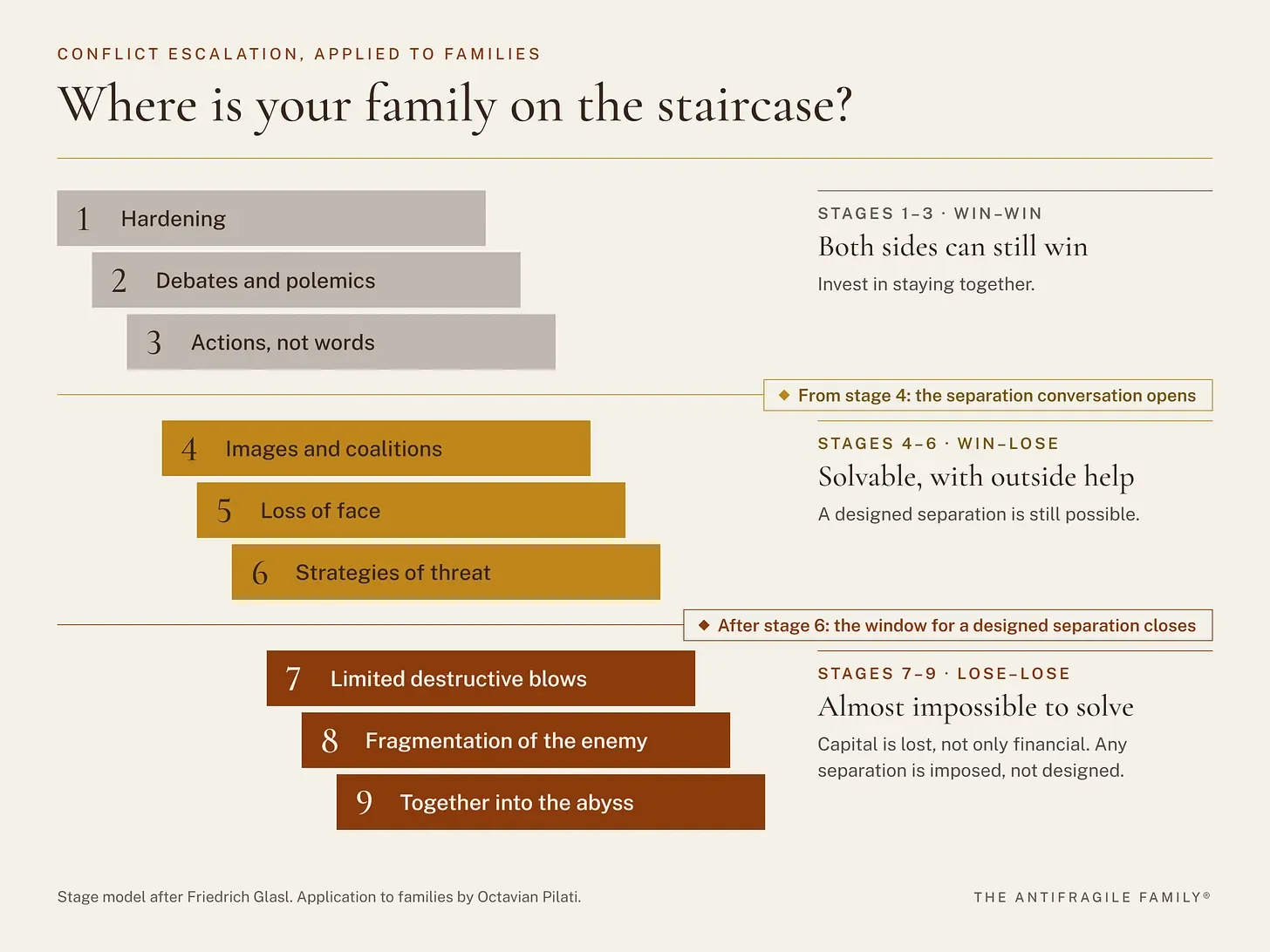
Glasl’s stages are a simplification of conflict. It ignores the randomness of conflict and its irrationality. But they serve as a good overview nevertheless. The model helps your thinking and categorization of conflict in your family.
In short: once conflict becomes a constant battle, you should probably separate. Once litigation becomes the norm, it is high time to separate.
In general, I suggest any family has regular separation check-ins as part of their governance. Not only the option of it, but the active discussion about it. Are we still working well together? Would we choose to work with each other, if given the choice? Are we still thriving as a family? Is everyone in the family flourishing? What could we improve? How can we improve? Or are we too far gone? Regularly speaking about it is the best way to catch problems early. And it is the way to not miss the point of no return. Stages 7-9 is where capital is lost, not just financial. Trust me, a peaceful and consensual separation is better than one after a family war. I have lived it, and it is grueling and exhausting.
Separation in practice.
There are several escalation steps needed in practice to separate. First, try to talk about it internally. However, rarely does this work out on its own. This is where, in the next step, mediation is needed. A neutral person who sits between the family members and helps guide the conversations and debates. Ideally in your governance you have defined the separation process ahead of time. This way, even if the conflict has reached a dire stage, there is a process to follow if people want to separate. Then any advisor or lawyer can help you by guiding the process. In more extreme cases, therapeutic support may be needed. Once the conflict has become highly personal, we need to depersonalize it. Separation is personal in a family. Separation is usually not just a personal and task issue, but often also a value conflict and a structural conflict. We have a stew with all four types of conflict thrown in the mix.
In general, a conflict will intensify over time and then weaken after its height. When you decide to negotiate a separation, even if the process is defined, you will reach a stalemate. The important thing is not to stop at the stalemate. We did that; it was horrible. Find a way to break through the stalemate. If you fail to separate peacefully, the consequence is worse. Stay at it and find a way to a negotiated solution and settlement. Separation is not the end of the world for a family. Financial separation does not mean you cannot hold a family gathering every year. It does not mean you cannot continue to like and love each other. It does not mean you have to stop spending time together.
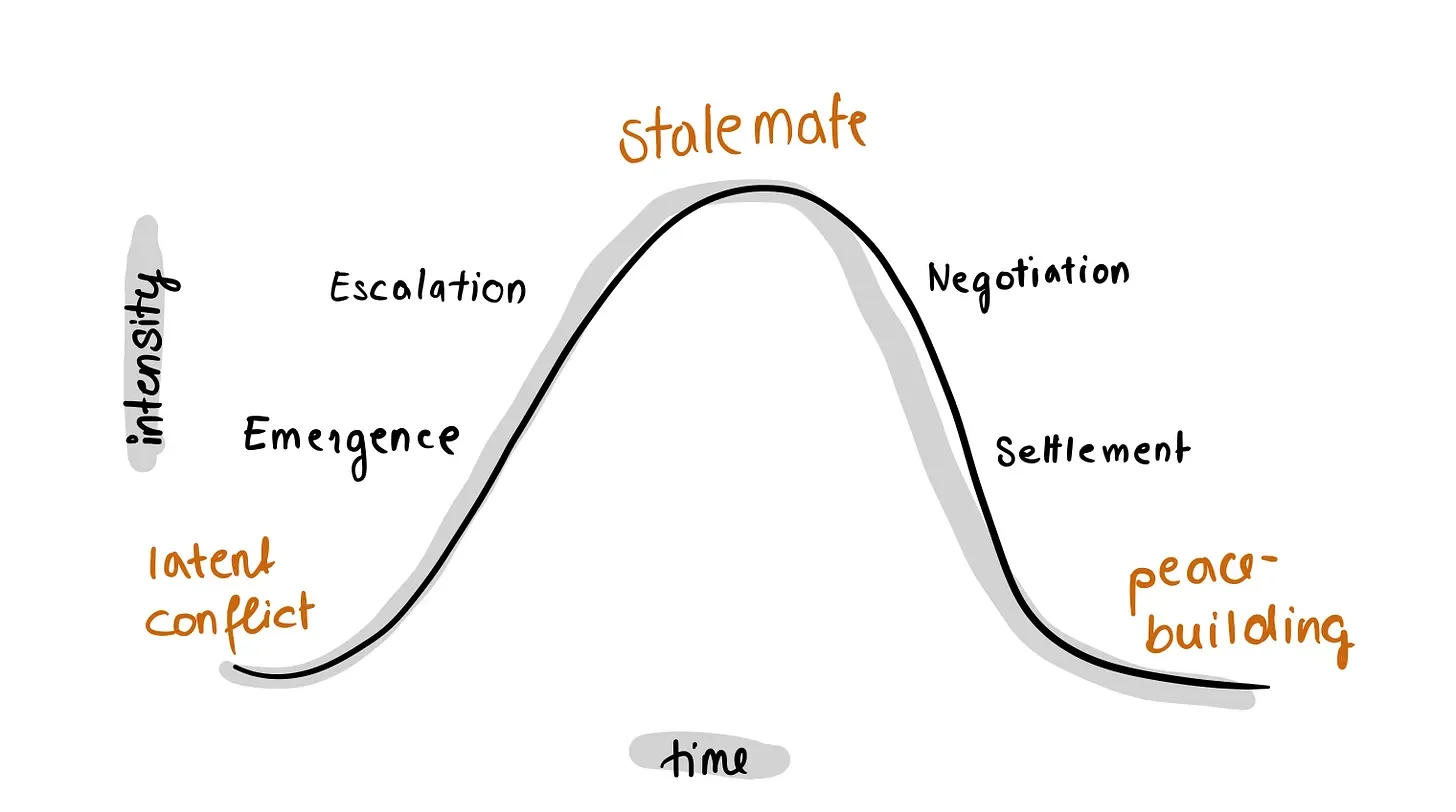
Conflict over time: Graphic by The Antifragile Family
Once the conflict is too far gone, arbitration and litigation are the only options left. This needs to be avoided at all costs, because the cost of it can be everything.
Final Words
Staying together as a family needs to be a choice, not a compulsion. Yes, we have an obligation to our ancestors and future generations. But, this obligation needs to be chosen. This obligation makes us responsible for keeping the family and the wealth thriving. And sometimes this can only be achieved through separation. A difficult decision. A vital decision. A decision that no one wants to make. Yet not all families are meant to stay together. If those stay anyway, it may cost them everything.