Signs of a Fragile Family Culture
Part 3 of 4: Spotting the fragile family — silence, rage, and the outsiders we kept out.
Yes, our estates were seized in 1945. Yes, they were returned ragged to us in 1955. However, our fragility has its origin in our family culture, not from some external factor. We had lost clarity since the Dissolution of the Habsburg Empire. We had lost our sense of purpose, our direction. The fragility finally exposed itself when our crisis kicked off in 2014. We broke apart as a family. Our family could not handle the financial fiasco we had to face. I remember sitting with our lawyer, hearing that someone in the family had leaked crucial information. Information that had just undone months of work. I despaired at the mistrust and intrigues while facing the odds. It robbed us of the sliver of hope we had. Had we pulled together as a family and faced the challenge together, we might have retained our estates. And we might just have come out stronger than we went in.

Octavian during the crisis
This is the third piece in a four-part series on where family fragility actually hides. Part 1 looked at the balance sheet. Part 2 looked at the chain of command — who decides, and what happens when only one person or no one can. This one looks at culture: the assumptions, habits, and unspoken rules that decide whether a family bends under pressure or breaks.
Unproductive Conflict Culture
I still remember how we used to have conflicts. If an issue were even addressed in the first place, it would quickly devolve into a shouting fest. I can still feel myself seething with rage in any typical heated dispute when I was talked down upon. We would not talk about issues, and it was frowned upon to address them, particularly if you were the younger counterpart. This was very much embedded in our family conflict culture. Respecting the elders was interpreted in a way that challenging them was unthinkable. Thus, we would alternate between silence and rage.
Conflict is part of being in a family. Just as it is part of being part of any team. However, family conflict has a particular itch to it. The close relationships make it so much harder to have conflict productively. At the same time, they have the potential to make conflict easier. Whether conflict is easier or harder for a family essentially depends on the level of psychological safety in the family and the level of trust they have with one another. Another caveat to interfamily conflict is that most family members will have multiple roles. For example, you may be the patriarch, a father, a brother, a husband, and a son. Several different positions. This makes family conflict complex. More complex than a typical workplace conflict.
Most families have an unproductive conflict culture. And this can come in two opposite faces. One is conflict avoidance dressed up as harmony; the other is a free-for-all rage fest with no regard for an actual outcome. Both rarely harvest a productive outcome from the dispute. So those are two clear signs of a fragile family. The important part is more about how conflict is being handled. Even if the conflict devolves into a shouting contest, it can still have productive elements as long as the conflict is task-focused. Task-focused means that the dispute is about a thing. Conflict in families, however, can quickly turn into relationship conflict, which turns on people rather than issues. Thus, people start fighting about who is behaving incorrectly etc. This has been studied extensively by Jehn in 1995 and 1997.
The counterexample is a family where an issue can be addressed by any member, the issue is then discussed in a direct and respectful manner, and then there is some sort of end result to the discussion. This does not mean that every dispute will have a productive outcome. However, a productive manner of addressing will increase the odds of a productive outcome manyfold.
There are many cases of unproductive conflict in families. It is one, if not the most crucial aspect of becoming an antifragile family: the ability to have productive conflict. A famous case that illustrates the destruction of a bad conflict culture is the Koch Family. When Fred Koch Sr. died in 1967, a toxic dispute between his four sons ensued. It ended in a two-vs-two conflict that did not end till 2001 — 34 years of fighting each other. That is nearly half the average person’s lifetime spent fighting over the family assets. The brothers would not even talk to each other at their mother’s funeral. The litigation costs were enormous, not just financially, but also emotionally and timewise.
Lack of clarity
Who is responsible for what? Who has the power to decide what? What is expected of whom? When is the time ripe to get involved? How are we going to go about this? These are the sort of questions that stay unanswered in a fragile family. While not all, many of these topics stayed unclear in our family. My father did attempt to bring clarity to these, but ultimately the effort failed. We were ever unable to create proper clarity. Even when I believed I had things figured out, I would learn that it was otherwise. While ambiguity is part of life and the hallmark of an antifragile family is to be able to handle ambiguity well, it is not something that should reign internally.
When times are good, a lack of clarity will not immediately cause any problems. It will slowly create cracks in the family’s foundation, however. And said cracks will deepen under pressure until the foundation shatters. When times get tough, clarity is paramount. It needs to be clear who is in charge of what, what everyone's responsibilities are, what is expected of every family member, and how we handle any given situation as a team.
When we faced the crisis, we lacked clarity. This wasted vital time, resources, and energy. Instead of jumping into problem-solving mode, we had to figure stuff out first. Or in more accurate words, we tried to figure things out. However, with the pressure being high, we could not, so we trod into the crisis in unclear terms.
However, there is a caveat to clarity. Clarity goes both ways. Some families try so hard to create clarity that they will overregulate themselves. Your governance complexity needs to match the family complexity. A first-generation family with one family business will not need the same amount of regulation as a sixth-generation family with several businesses, trusts, and a family office. However, they are often advised that they need it. So, in essence, over-complexity is just as harmful as under-complexity. González-Cruz, T., Clemente-Almendros, J.A., & Puig-Denia, A. found empirical support for this.
A good example of lack of clarity is the Bancroft Family (previously the owners of Dow Jones). By the fifth generation, 20 family members owned the company, and there was no clear structure. When an offer from the Murdoch family came in in 2007 to buy the company, chaos ensued. There was no clear line, no family representative, and thus different factions formed within the owning family. This even resulted in some public embarrassment when a family member diverged at a press conference. While everyone thought the deal would never go through, in the end it did, ending 105 years of family ownership. A sale is perfectly fine to do; however, the Bancroft family trod a painful path to the close.
More on this topic in The Undeclared Family.
No mechanism for outside renewal
How readily does your family accept outsiders into their fold? How readily do they listen to outside perspectives, ideas, and advice? How are spouses treated? The answers to these questions can tell a lot about a family. Especially how fragile their culture is. Many families go through a lot of effort to protect their assets and legacy from outsiders. Even spouses. In my book, that is a clear sign of fragility. It borders on paranoia. Just looking at the problems we had from the rejection of spouses in my family is enough for me. It creates so much unnecessary conflict, tension, and resentment. You cannot fully keep outsiders out. They have an influence on your family members. And by actively trying to keep it out, all you are doing is moving this influence below the surface, where it disappears from sight.
Not only that, but outside influence is an important factor in innovation and the evolution of a family. Of course, there are threats to the family from the outside, but there is also a real opportunity. The trick is to protect from the threats and to harness the opportunities. Sadly, most focus so much on the threats that they will opt to keep everything away. Of course, the opposite, as usual, is not good either. Some families are so open that they are infested with vultures and riddled with incompetent advice. The balance lies in selecting by competence.
Different perspectives and opinions are crucial for innovation. Conflict creates constraints, which again are paramount for creativity to take place. Now, we have covered how productive conflict is important. Yet, if the family closes themselves in, the precursor needed for conflict vanishes altogether. A healthy amount of tension needs to be cultivated, which is best done by allowing outside impulses, be it from spouses, experts, friends, or simply employees. “Birds of a Feather” by McPherson, Smith-Lovin, and Cook is a great piece of academic work, which shows that organisations with people who are too homogeneous become too agreeable, reducing conflict. This will often lead to groupthink and thus make them blind to innovation and outside competence. This is poison for the longevity of your family’s success.
This needs to be actively fought against, as we can infer from Davis, Allen, and Hayes’ paper “Is Blood Thicker Than Water?”. We tend to trust our family more readily than anyone else. At least in healthy families. Now, while this has great upside in working together and trust increases the speed at which things are decided and happen, it leads to the dynamic mentioned above. Does this mean that an outside CEO is the answer? No, it does not. Outside CEOs are a mixed bag, just as with any human involved, the individual’s competence is the deciding factor. An outsider is not automatically more competent than a family member, just as a family member is not automatically more competent than an outsider.
The Schwinn Family is a prime example of this. Schwinn Bicycle used to be a heavyweight in its industry. However, they slowly worked themselves into bankruptcy. They had it as family policy that only family members could hold leadership positions in the C-suite. Not only that, but women were not allowed in the C-suite either, reducing the talent pool further. They missed several crucial moments of innovation: lighter bicycle frames and the trend to mountain biking, for example. When they realised, they were too late to catch up and too burdened by debt to salvage anything. Neither through a public offering nor a company sale, no one wanted to touch the company with a barge pole. It ended in bankruptcy, ending the reign of an American icon in the industry.
More on spouses in The Spouse Fatality.
Preservation without renewal/stagnation
What is your family’s growth strategy? How strong is the entrepreneurial drive? How does the growth of your wealth compare to your family’s growth? All questions we never asked ourselves. All questions that, if they had been examined, would have made the difference. We did not manage to financially outgrow the increase in family members. There never was a clear plan and thus we missed ample opportunity. Stewardship was the name of the game. Aim for the stars to reach the moon. The same holds true for family wealth. If you aim at keeping pace with inflation, you will fall short. Not only that, but you need to keep pace with the growth of the family, otherwise, your per capita wealth decreases.
Stewardship also leads to another phenomenon — the stewardship trap (the shadow to the stewardship theory by Davis, Schoorman, and Donaldson (1997)). Most stewards are so focused on not making any mistakes, on not costing their heirs their inheritance, that they will become defensive and risk-averse. The courage that has built the fortune is actively discouraged. Not just discouraged but feared. Whenever fear reigns, nothing good comes of it. In decision-making science, there is something called defensive decision-making. Stewardship often leads to this. We stop making the courageous gut-feeling decisions that we know are right, but we cannot explain. Instead, we opt to go with what we can explain (Gerd Gigerenzer). This is mediocre at best. And thus the decline is initiated.
When the focus goes onto legacy preservation, no one asks the difficult questions any longer. Do we still need this? Could we simplify this? How could we do this differently? Is our strategy still valid in modern times? And so on and so forth. This is a clear marker of fragility — the reluctance to renew. This goes further than the previous point. “We have always done it this way.” — the most dangerous words in any organization. The same holds true for families.
According to Gerd Gigerenzer, Aetinger and colleagues the cost of defensive decision-making in organizations is 10,8% of the yearly revenue. Imagine what this means on a long timescale for your family. The table below shows a hypothetical calculation of the compounded costs.
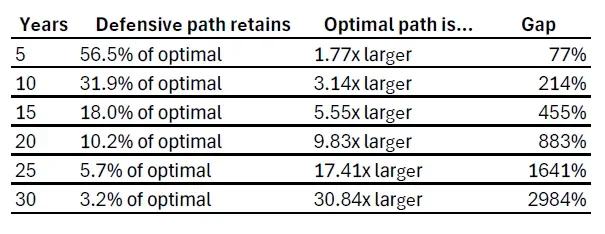
The Rothschild Family is an example of this marker. By 1899, their capital exceeded that of the five largest German joint-stock banks combined. However, the entrepreneurial spirit that had built the Rothschild fortune had long been gone. The family refused to take on external capital to fuel growth and managed their wealth very conservatively. The fourth generation had become incredibly risk-averse. Not only that, but historical accounts show that they were increasingly focused on not being the one to lose any of it. Additionally to this, they were deeply distrustful of anyone not a male Rothschild; this was the main reason their US expansion did not work well. No one from the family wanted to relocate, yet they did not bestow proper authority on their US manager. The Rothschilds remain an incredible success story, but from the 4th generation onwards, the growth that could have been just never materialized. A culture of defensive decision-making coupled with an urge for control held them back.
Final Words
We did not address the fragility in our family culture and paid a bitter price for it. The world is full of further examples of what can happen if you do not address this. This was part three of the four-part series on spotting fragility in your family. Keep the markers at heart. Identify whenever you see them in action in your family. Acceptance is the first step to betterment. By identifying fragility in your family, you are making the first step.
Reference List
Artinger, F.M., Gigerenzer, G., et al. (2025). “Coping with uncertainty: The interaction of psychological safety and authentic leadership in their effects on defensive decision making.” Journal of Business Research, 190.
Davis, J.H., Allen, M.R., & Hayes, R.D. (2010). “Is Blood Thicker Than Water? A Study of Stewardship Perceptions in Family Business.” Entrepreneurship Theory and Practice, 34(6), 1093–1116. DOI: 10.1111/j.1540-6520.2010.00415.x
Davis, J.H., Schoorman, F.D., & Donaldson, L. (1997). “Toward a Stewardship Theory of Management.” Academy of Management Review, 22(1), 20–47.
Gigerenzer, G. (2007). Gut Feelings: The Intelligence of the Unconscious. Viking.
González-Cruz, T., Clemente-Almendros, J.A., & Puig-Denia, A. (2021). “Family governance systems: the complementary role of constitutions and councils.” Economic Research-Ekonomska Istraživanja, 34(1), 3139–3165. DOI: 10.1080/1331677X.2020.1867603
Jehn, K.A. (1995). “A multimethod examination of the benefits and detriments of intragroup conflict.” Administrative Science Quarterly, 40(2), 256–282.
Jehn, K.A. (1997). “A qualitative analysis of conflict types and dimensions in organizational groups.” Administrative Science Quarterly, 42(3), 530–557.
McPherson, M., Smith-Lovin, L., & Cook, J.M. (2001). “Birds of a Feather: Homophily in Social Networks.” Annual Review of Sociology, 27, 415–444. DOI: 10.1146/annurev.soc.27.1.415